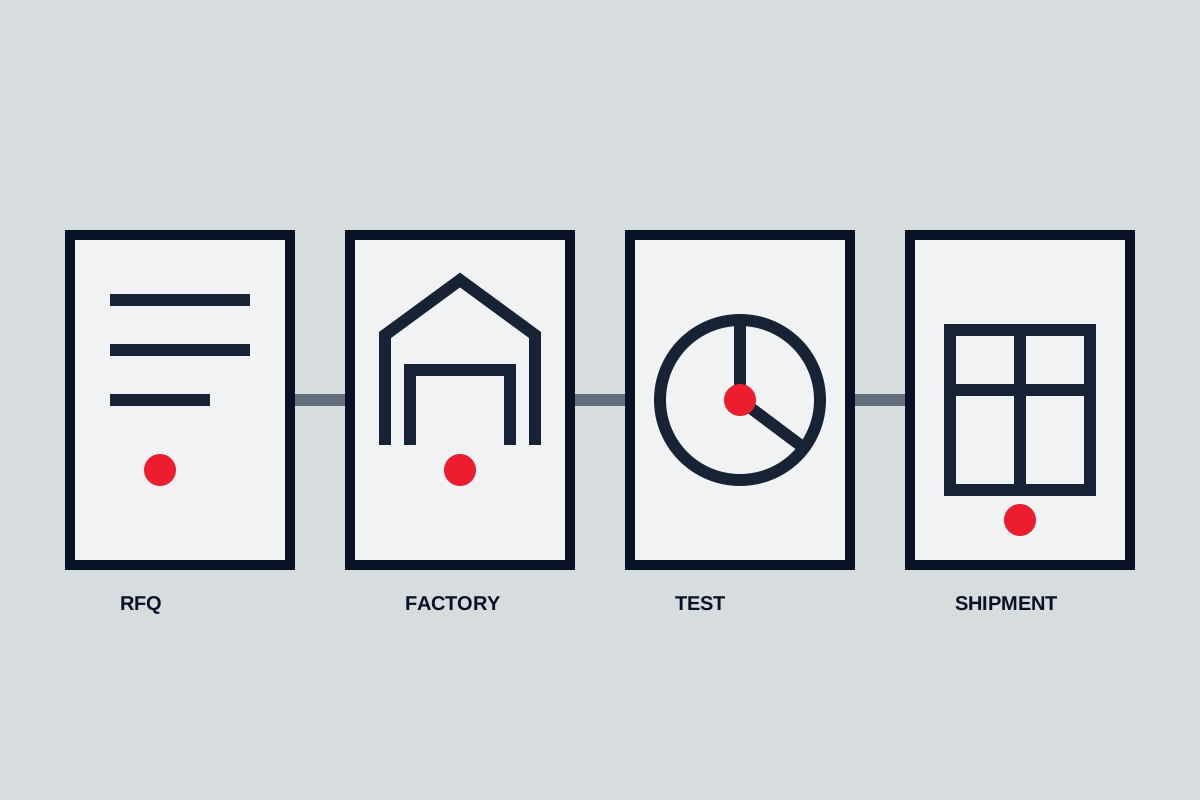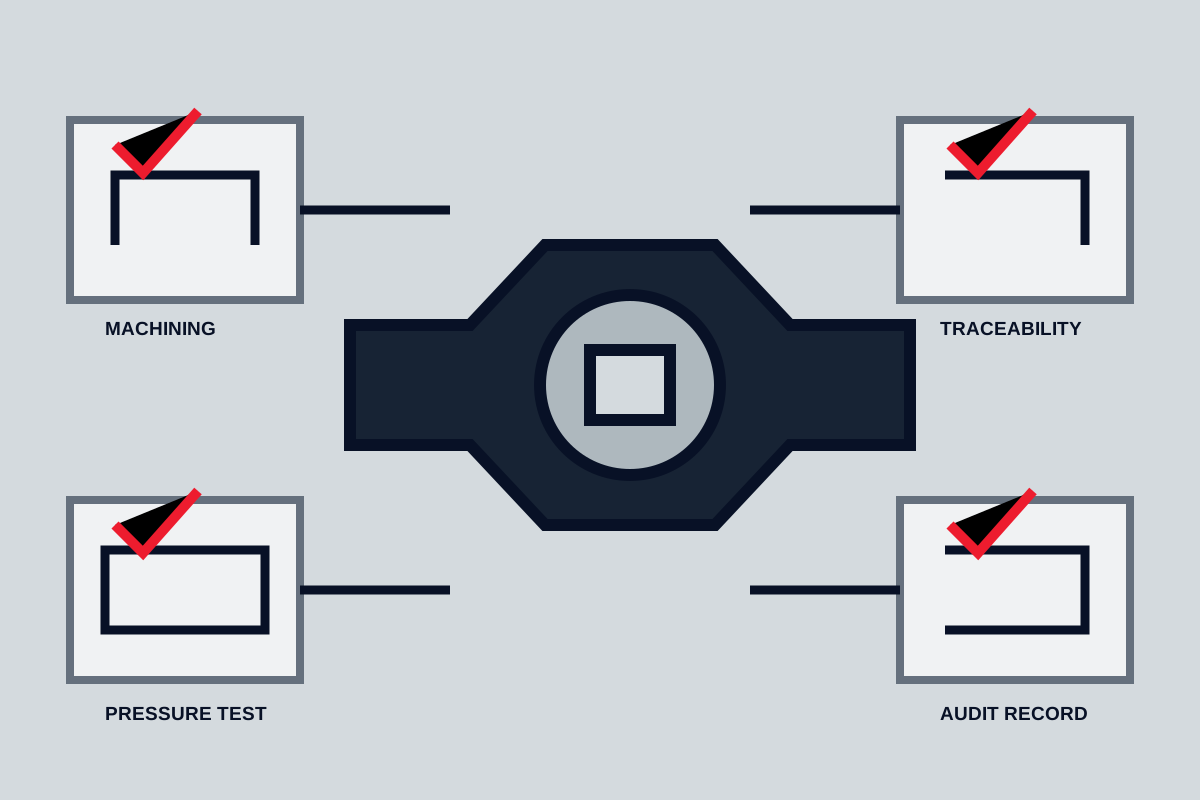


A supplier quality certificate can support supplier qualification, but it does not automatically prove that the product on your purchase order conforms. Verify what the document certifies, who issued it, which legal entity and site it covers, and whether its scope connects to the exact product, configuration, and order you are placing.
Start by identifying what the certificate actually proves
The first question is not whether a certificate looks authentic. It is what claim the document is designed to support.
A management-system certificate, such as an ISO 9001 certificate, is evidence that a named organisation’s quality management system was assessed against a stated standard and scope. It is not, by itself, a certificate of conformity for a particular product model, material batch, drawing revision, or purchase order.
Other common documents answer different questions:
| Document type | What it may support | What it does not establish by itself |
|---|---|---|
| Quality-management-system certificate | The certified organisation and covered site have a management system within a stated scope | Conformity of a specific item, batch, or order |
| Product certificate or approval | A stated product, configuration, or product family meets a defined scheme requirement, subject to its conditions | Coverage of variants, sites, ratings, or revisions not listed |
| Test report | Results for an identified sample tested by a stated method under stated conditions | Performance of every future unit or a different configuration |
| Inspection report | Findings on the items, samples, or lots identified in the report | Ongoing conformity of uninspected production |
| Material certificate | Declared chemical, mechanical, heat-treatment, or other material results for an identified heat or lot | Traceability to supplied parts unless markings and records link them |
| Supplier declaration | The supplier’s statement of conformity or compliance | Independent verification unless supported by applicable evidence |
Request the complete document rather than a logo, a screenshot, or the first certificate page. Annexes, multisite schedules, exclusions, revision records, and referenced scope statements may contain the information that determines whether the certificate is relevant.
Do not use a document for a question it was not intended to answer. A quality-system certificate can be a useful supplier-qualification control. A product approval can be relevant to a model-specific requirement. A test report may support a stated performance condition. None should be silently substituted for the others.
Verify the issuing body, certificate number, and current status
A certificate can be genuine in appearance and still be expired, suspended, withdrawn, superseded, altered, or issued for another organisation. Check the document against an independent source where possible.
Start with the details shown on the complete certificate:
- certificate number;
- name of the issuing certification body or scheme operator;
- standard or certification scheme named;
- issue date, expiry date, and revision or reissue details;
- certificate-holder legal name and address;
- certified scope and listed site information;
- accreditation mark, if one is shown and accreditation is required by your specification.
Then search the issuing body’s official certificate directory using the certificate number and certificate-holder name. If a directory is unavailable, contact the issuing body through contact details obtained independently from its official website, not solely through an email address or telephone number printed on the supplier-provided PDF.
Record whether the issuer confirms the certificate number, certificate holder, standard or scheme, status, validity dates, and covered scope. Keep a dated record of the search method and result in the supplier-qualification file. This creates an auditable basis for the decision and helps identify future changes.
An accreditation mark is not sufficient proof on its own. If accreditation matters to the buyer’s requirement, confirm that the certification body is accredited by the relevant accreditation body and examine whether its accreditation scope is relevant to the scheme, standard, and activity in question. Accreditation may not apply to every service, location, or programme displayed in supplier documentation.
A QR code, stamp, signature, or polished certificate layout should be treated as a lead for verification, not as verification itself. The practical control is an independent issuer-status check.
Match the certified legal entity and covered site to the order
A certificate normally applies to the legal entity and sites named on it. The supplier brand, group name, sales office, trading company, warehouse, contract manufacturer, and payment beneficiary may all be different entities. Establish which organisation will actually manufacture, inspect, and release your goods.
Compare the certificate-holder name and address with the supplier’s quotation, purchase order, proposed contract, invoice entity, and payment instructions where appropriate. Minor differences may be legitimate, such as an abbreviated legal suffix or a documented address update. They still require explanation and a traceable link.
For purchases with meaningful technical, safety, or commercial risk, identify at least these roles:
- the contracting seller;
- the legal entity named on the certificate;
- the physical manufacturing site;
- the site carrying out critical processes, such as welding, coating, machining, calibration, assembly, or testing;
- the organisation responsible for final inspection and release.
Read any certificate annex or multisite schedule carefully. A corporate certificate may list multiple facilities, but that does not mean every company location is covered. Likewise, a head-office certificate does not automatically cover a subsidiary, a separate factory, a warehouse, or an outsourced process provider.
Where available, an official company register can help confirm a supplier’s registered legal identity and address. That check addresses legal-entity information only. It does not demonstrate factory capability, ownership of equipment, product authenticity, quality performance, or the actual production location for your order.
If the seller proposes manufacture at a site not named on the certificate, do not assume coverage. Ask whether the site is separately certified, included in a multisite arrangement, or operating as an external provider under the certified entity’s controls. The answer may be acceptable for the purchase, but it should be assessed against the contract and product risk rather than inferred from a group-level certificate.
Read the certified scope before treating it as relevant
A current certificate can be genuine yet irrelevant to the work you are buying. The certificate scope is the bridge between the certified management system and the supplier activity being considered.
Compare the scope wording with the required activity. For example, a purchase may require design, machining, pressure testing, coating, final assembly, electrical testing, calibration, or distribution. A certificate scope referring only to distribution or trading does not establish that the named organisation manufactures the ordered equipment. Similarly, a scope for general fabrication may not answer whether the supplier controls a specialised process required by the contract.
Review the following points:
- the stated activities and product families;
- covered locations and site-specific activity allocations;
- exclusions or limitations;
- the standard or scheme edition stated on the certificate;
- referenced annexes and schedules;
- whether translated scope wording matches the original document;
- whether key processes are performed internally or by external providers.
Broad scope wording requires judgment. A broad statement may be suitable for low-risk supplier prequalification, but it does not prove that a supplier has the machinery, qualified personnel, process approvals, measuring capability, or inspection controls needed for a particular component.
If wording is vague, translated, incomplete, or inconsistent with the proposed work, request clarification from the supplier and, where necessary, from the certification body. Keep the distinction clear: scope relevance is an applicability assessment. It is not proof that the ordered product meets its drawing, performance requirements, regulatory obligations, or contractual acceptance criteria.
Link certificate coverage to the exact product and purchase order
Order-level conformity requires order-level evidence. A supplier certificate is one control in that evidence chain, not the chain itself.
Before release, compare the purchase order and technical package with the documents intended to support conformity. The needed records depend on the product and the consequences of failure, but the comparison commonly includes:
- purchase-order number and line item;
- supplier part number, model, and configuration;
- drawing number and revision;
- technical specification and approved deviations;
- bill of materials or controlled material requirements, where relevant;
- applicable inspection and test plan;
- agreed acceptance criteria and release conditions;
- traceability, marking, packaging, and preservation requirements.
For a product certificate or approval, verify the precise model, variant, ratings, material option, manufacturing site, and limitations stated in the approval. Do not extend an approval to an unlisted configuration merely because the product name is similar.
For a test report, match the sample identification, test method, date, stated conditions, result, and limitations to the ordered item. A pressure test performed on one configuration, for example, may not support a different material, seal arrangement, pressure class, temperature range, or manufacturing revision. A test report establishes only what its sample and method support.
For material documentation, verify the material designation, heat or lot number, chemical and mechanical results where specified, and traceability link to the finished parts. The required link may involve permanent markings, cut-piece records, process travelers, packing lists, or a traceability matrix. A material certificate without a defensible link to the supplied item is not evidence that the item contains that material.
Supplier declarations should be retained when contractually required, but they remain supplier statements unless they are supported by applicable certification, test, inspection, or traceability evidence. The appropriate level of independent checking depends on the product’s criticality and the contract.
Use the certificate as one control in a proportionate qualification plan
The practical objective is not to collect the largest document pack. It is to establish evidence proportionate to the consequences of nonconformity, the complexity of the product, the supplier’s role, contractual requirements, and applicable regulatory obligations.
A supplier-certificate verification record should normally contain:
- The complete certificate, including annexes, schedules, and translations used in the assessment.
- A record of issuer verification, including date, directory or contact method, status, and discrepancies.
- The legal-entity and site comparison against quotation, contract, purchase order, and proposed manufacturing location.
- A scope assessment identifying what activities are covered, excluded, unclear, or outside the certificate.
- An order-level document matrix showing what evidence is required for each critical requirement.
- The resulting supplier-approval decision, limitations, and actions required before release.
For a low-risk standard item, a current and relevant management-system certificate plus normal incoming checks may be sufficient. For engineered, safety-related, regulated, or high-consequence equipment, additional controls may be necessary. Depending on the contract, these can include first-article approval, a review of manufacturing records, pre-shipment inspection, witnessed testing, independent laboratory testing, traceability review, or incoming inspection.
These are proposed verification actions, not evidence that an inspection, audit, or test has already taken place. Define them in the purchase order, quality agreement, inspection and test plan, or acceptance criteria before production where possible. A late request for evidence may leave the buyer with limited ability to correct a design, material, or process issue.
Frequently asked questions
Does an ISO 9001 certificate prove that a specific product meets my specification?
No. An ISO 9001 certificate concerns a quality management system within a stated scope. It does not, on its own, prove that a particular model, batch, drawing revision, or purchase order meets your specification. Product conformity needs order-specific evidence such as inspection records, test results, material traceability, product approvals, and release documentation as applicable.
How can I check whether a supplier certificate is still valid?
Use the certificate number and holder name to search the named issuing body’s official directory. If no directory is available, contact the issuer through independently obtained official contact details. Confirm the current status, validity dates, certificate holder, sites, standard or scheme, and scope. Record the date and result of the check.
Does a parent company’s certificate cover a subsidiary or another factory?
Not automatically. Check the exact legal entity, address, site schedule, and annexes. A parent-company or head-office certificate may not include a subsidiary, trading company, warehouse, or factory that will make your goods.
What documents should I request in addition to a supplier quality certificate?
Request documents that address your actual acceptance requirements. Depending on the item, these may include the approved drawing and revision, product certificate or approval, inspection and test plan, material certificates, traceability records, test reports, certificate of conformity, packing list, and final inspection or release record. Specify the required documents and acceptance conditions in the contract or purchase order.
Treat a supplier quality certificate as a bounded piece of evidence: verify the issuer and status, match the legal entity and manufacturing site, assess the scope, and then require product- and order-specific evidence for the requirements that matter. If any link is missing, resolve it before relying on the certificate for supplier approval or product release.