

Choose between an AC motor and a DC motor by matching the complete drive system to the load—not by comparing motor labels or nameplate power alone. The decisive inputs are continuous and peak torque, speed range, acceleration, braking and regeneration, available supply, feedback requirements, environment, maintenance access, and the difficulty of changing an existing machine.
A three-phase AC motor with a variable-frequency drive (VFD) is often the practical choice for a new installation because it avoids brushes and can be integrated with modern control systems. A DC motor can still be appropriate where an existing DC system is serviceable, where the machine depends on a known armature-and-field control arrangement, or where the required torque-speed envelope and retrofit constraints favor retaining it. Neither technology is universally better.
Define the Load Before Comparing Motor Types
Start with the machine duty. Identify the torque required at each operating speed, the normal and peak load, acceleration time, deceleration time, starting frequency, driven inertia, and the proportion of time spent at each condition. Also establish whether the load can drive the motor during deceleration. An overrunning conveyor, hoist, winder, centrifuge, or test stand may require a regenerative or four-quadrant drive rather than simple motoring control.
Classify the load as a first approximation:
- Constant torque: Conveyors, positive-displacement pumps, compressors, mixers, and many machine tools require broadly similar torque across a speed range. The motor and drive must provide the required torque continuously at low speed, where cooling may be reduced.
- Variable torque: Centrifugal fans and pumps generally require less torque as speed falls. A VFD can reduce speed and power demand, but the actual process requirement and pump or fan curve still control selection.
- Constant power: Winders, machine tools, and some traction duties may require torque to decrease as speed rises above base speed. Field weakening or another controlled constant-power region must be confirmed from the motor and drive data.
Do not use rated kilowatts or horsepower as the only sizing input. A motor may have adequate rated power but insufficient continuous torque at the minimum speed, inadequate overload capacity during acceleration, or excessive thermal stress during repeated starts. Check the motor torque-speed curve, drive overload rating, duty cycle, cooling method, and permitted speed range as one system.
Collect the following before requesting quotations:
- Available voltage, phase, frequency, short-circuit conditions, and control-panel limitations
- Required minimum, nominal, maximum, and possible overspeed values
- Continuous torque, peak torque, acceleration torque, and duration of each condition
- Load inertia, coupling ratio, starting frequency, and stopping time
- Whether the load regenerates during deceleration or can back-drive the motor
- Ambient temperature, altitude, dust, moisture, corrosive exposure, washdown, and hazardous-area requirements
- Available feedback, such as an encoder or resolver, and the required speed or position performance
- Existing mounting, shaft, brake, cable, control, and safety-function arrangements for a retrofit
These inputs determine whether AC or DC is suitable more reliably than a general comparison of motor construction.
Compare Supply and Speed-Control Requirements
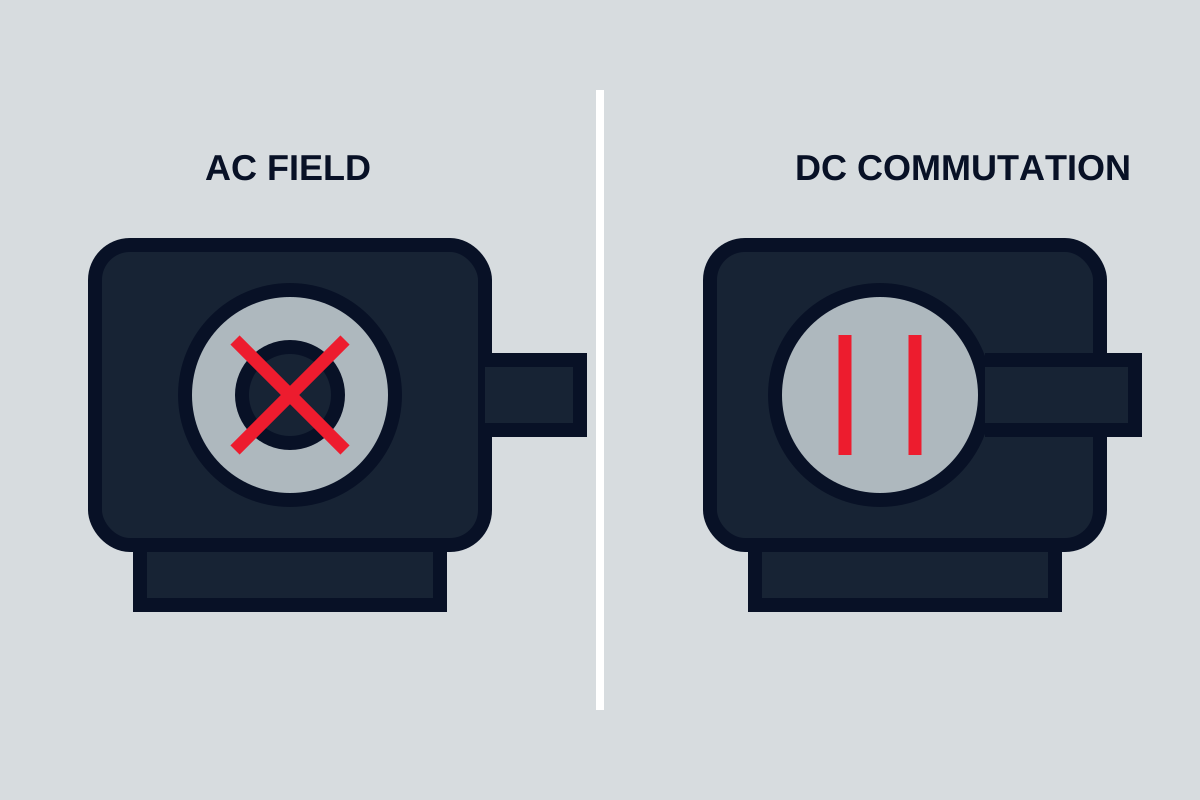
A conventional industrial DC drive normally controls armature voltage and current and may control the field current separately on a shunt-wound motor. This arrangement gives direct control of torque-producing current and motor speed, but it also creates additional field-control, commutation, and maintenance considerations. A permanent-magnet DC motor has a different field arrangement, so its allowable control range and field-weakening options must be assessed separately.
An AC system usually combines a three-phase induction or permanent-magnet motor with a VFD. The drive converts the incoming electrical power into controlled output voltage and frequency. Basic scalar, or V/Hz, control may be adequate for uncomplicated variable-torque loads. Sensorless vector control can improve torque control over a wider range, while closed-loop vector control uses an encoder or other feedback device when the application requires tighter speed regulation, controlled torque at very low speed, or coordinated motion.
The distinction matters because “AC motor” does not describe one control performance level. A properly configured closed-loop AC system can behave very differently from an induction motor operated with basic scalar control. Performance depends on motor data, drive capacity, tuning, feedback quality, load inertia, cable installation, and the control mode selected. The ABB technical guide describes how AC variable-speed technology developed partly to provide performance historically associated with DC drives, while retaining the construction advantages of AC motors.
Check the complete supply arrangement rather than only the motor input. A DC installation may use a dedicated rectifier or DC drive and may already have suitable field and braking hardware. An AC retrofit may need a new VFD, transformer or line reactor, input protection, output filtering, encoder interface, braking resistor, regenerative front end, or control-system changes. Conversely, an existing AC supply may make an AC motor and VFD easier to integrate than a new DC power section.
For either system, confirm the controller’s compatibility with the exact motor. The written review should cover rated current, overload capability, field or excitation requirements, feedback device, minimum speed, maximum speed, motor thermal model, braking mode, and safety functions. Do not infer these details from a similar model or from the motor type alone.
Evaluate Torque, Speed Range, and Braking Behaviour
DC motors have historically been used where the machine needs controlled starting torque and a wide adjustable-speed range. Their armature current is closely related to torque, while field control can extend the speed range above base speed in suitable designs. These benefits do not remove the need to check commutation, armature current, field loss, cooling, and the motor’s actual torque-speed envelope.
Modern AC drives can provide strong starting and low-speed torque, but the result depends on the motor, control method, feedback, and tuning. An induction motor with basic V/Hz control should not be assumed to deliver the same low-speed response as a correctly sized closed-loop vector system. A high-inertia load, rapid acceleration, or frequent reversal may require more current and a different drive rating than steady operation at the same motor power.
Above base speed, the motor may enter a field-weakening or constant-power region. The available torque normally falls as speed rises in this region, and the allowable overspeed is specific to the rotor, bearings, balance, cooling, and manufacturer limits. Never set an overspeed value only because the drive can produce the required frequency.
Braking requires the same level of scrutiny. Deceleration can return energy to the DC link or DC bus. Depending on the duty, the system may need:
- A mechanical brake for holding or emergency stopping
- A dynamic-braking resistor to dissipate regenerated energy
- A regenerative drive or active front end to return energy to the supply
- Controlled plugging or reverse torque, where permitted by the equipment design
- A coordinated braking sequence for hoists, vertical axes, winders, or other loads that must not run away
Confirm resistor power, pulse energy, thermal duty, regeneration capability, stopping time, and brake sequencing from the application calculation. A drive that can decelerate an unloaded motor may not safely stop an overrunning load at the required frequency. Emergency-stop behavior must also be designed around the machine’s risk assessment and approved safety architecture rather than treated as an ordinary drive stop.
Compare Maintenance and Environmental Suitability
The main maintenance distinction is the commutator and brush assembly in a conventional brushed DC motor. Brushes wear, require inspection and replacement, and must maintain suitable contact with the commutator. Dust from brush wear, poor commutation, contamination, incorrect brush grade, or excessive current can affect reliability. The exact inspection interval depends on the motor, duty, speed, current, environment, and manufacturer’s maintenance instructions.
AC motors do not use brushes or a mechanical commutator, but they are not maintenance-free. Bearings, seals, cooling passages, terminal connections, insulation, feedback devices, and drive electronics still require attention. A VFD installation also introduces issues such as motor-cable length, reflected-wave voltage, electromagnetic compatibility, output-filter selection, and possible bearing-current mitigation. These conditions depend on the motor insulation system, drive switching characteristics, cable construction, grounding, and installation layout.
Environment can change the comparison. A DC motor with exposed brush access may be difficult to maintain in a dirty, wet, corrosive, or inaccessible location. However, an AC motor is not automatically suitable for that environment. Confirm the exact enclosure, ingress protection, cooling method, insulation system, ambient temperature range, altitude correction, corrosion protection, and hazardous-area approval where applicable. The drive enclosure and cooling arrangement require the same review.
An enclosed AC motor may be a practical choice where brush access is undesirable, but that is a conditional engineering conclusion. A separately ventilated motor may be necessary for extended low-speed constant-torque operation because shaft-mounted cooling decreases with speed. A DC motor may also require separate cooling or field-control limits. Use the manufacturer’s curves and instructions to determine the permissible continuous duty at the required speed.
Assess System Complexity, Efficiency, and Retrofit Cost
The commercial comparison should include the complete installed system, not just the motor quotation. Include the motor, drive, transformer or rectifier, line and output filters, braking equipment, feedback, cables, panel modifications, cooling, controls integration, commissioning, spare parts, maintenance access, and expected downtime during the change.
For a new machine, an AC motor and VFD may reduce mechanical and maintenance complexity in many applications, especially where a standard three-phase supply is already available. That does not establish a universal price, efficiency, or payback advantage. Power level, duty cycle, speed profile, energy price, harmonics, cooling losses, and the selected motor and drive affect the result.
For a retrofit, compare the condition and remaining supportability of the existing DC motor and drive with the risks of replacement. An AC conversion may require a new motor with different inertia, shaft dimensions, mounting, cooling, and rated speed. The VFD may require new cables, an encoder, an output filter, braking hardware, updated control logic, and changes to the machine’s safety functions. Mechanical adaptation and commissioning downtime may dominate the equipment purchase price.
Check these drive-system details before placing an order:
- Input harmonics, power factor, and whether a line reactor or active front end is needed
- Maximum motor-cable length and whether an output filter is required
- Motor insulation stress and bearing-current protection
- Drive heat loss, enclosure ventilation, and ambient derating
- Encoder or resolver compatibility and signal isolation
- Regenerative operation, braking-resistor sizing, and fault behavior
- Control-network compatibility, interlocks, safe torque off, and emergency-stop sequencing
- Availability of replacement drives, feedback devices, brushes, bearings, and other critical parts
Broad historical material, including the EPRI comparison, can help explain why AC drives displaced some DC applications as control technology developed. It should not be used as a current project cost or lifecycle calculation without matching the power range, operating profile, energy assumptions, and maintenance conditions.
Make the Selection and Define Verification Tests
Use the following decision rule: select the motor-drive combination that meets the required torque-speed envelope, braking behavior, environmental limits, controls interface, and lifecycle constraints with the lowest verified project risk. Select AC when its drive can provide the required low-speed torque, speed regulation, overload, braking, and thermal performance, and when the supply and retrofit geometry support the change. Retain or specify DC when the existing system is serviceable and well supported, or when the required duty and control arrangement are not justified by an AC conversion without further engineering.
Require the supplier or drive manufacturer to confirm, in writing, at least the following:
- Continuous and peak torque across the complete speed range
- Minimum permissible continuous speed and cooling arrangement
- Acceleration, overload, reversal, and stopping capability
- Field-weakening or overspeed limits, if applicable
- Braking method, regenerative capacity, resistor duty, and brake coordination
- Motor-drive compatibility, feedback requirements, and tuning procedure
- Insulation, cable, filtering, grounding, and bearing-current requirements
- Enclosure, ambient, altitude, corrosion, washdown, and hazardous-area limits
- Mounting, shaft, inertia, coupling, and mechanical brake dimensions
- Required commissioning data and fault-response checks
For a retrofit, verify shaft dimensions, mounting holes, coupling, rotation, rotor inertia, cooling airflow, cable routes, control signals, safety circuits, and brake sequencing before ordering. A proposed commissioning plan should include unloaded rotation and direction, current, acceleration, operating temperature, speed regulation, braking response, alarms, feedback loss, and emergency-stop behavior under approved site procedures. Those are verification steps—not claimed test results.
Common questions
Can a modern AC motor and VFD replace an existing DC motor?
Often, but not as a direct substitution. Confirm torque at minimum speed, acceleration, field-weakening behavior, braking, thermal performance, shaft and mounting dimensions, feedback, cabling, controls, and safety functions before approving the retrofit.
Which system is better for high starting torque and precise low-speed control?
Either can be suitable when correctly configured. The answer depends on the torque-speed requirement, overload duration, feedback, tuning, motor cooling, and drive rating. Do not use the AC or DC label as a substitute for a torque and control calculation.
Do DC motors always require more maintenance than AC motors?
Brushed DC motors add brush and commutator maintenance that a brushless AC motor does not have. AC systems still require bearing, cooling, insulation, cable, feedback, and drive maintenance. The environment and accessibility determine the practical burden.
What information is needed to size either drive?
Provide the supply, speed range, continuous and peak torque, acceleration and braking profile, inertia, starting frequency, environment, cooling arrangement, feedback, control interface, and mechanical dimensions. A nameplate power rating alone is insufficient.